
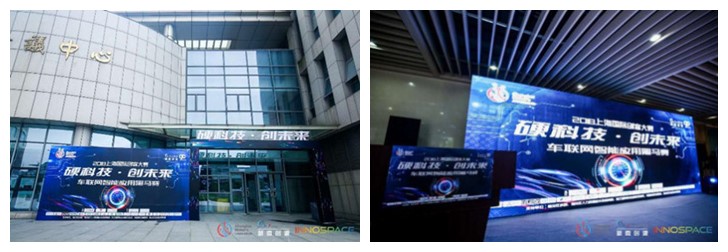
On the evening of 26 August, the final of the ‘Dark Horse Competition for Intelligent Applications in Connected Vehicles’, jointly organised by the Shanghai Municipal Science and Technology Commission, the Eastern Centre for National Technology Transfer, Innospace, New Micro Innovation Source and the Shanghai Institute of Microsystems and Information Technology of the Chinese Academy of Sciences, kicked off at the New Micro Building of the Shanghai Institute of Microsystems and Information Technology. The competition involved participants using hardware equipment provided by the organisers—including ARM development boards and sensors—along with cloud connectivity, to design innovative and pioneering applications for intelligent connected vehicles. Twelve teams from various research institutions, universities and enterprises took part in the competition.
The localisation of millimetre-wave radar technology in China has lagged behind, with the local production of chips being the primary limiting factor. As a leading domestic manufacturer of millimetre-wave radar chips, Sijie Microelectronics provided radar sensor modules for this competition. These modules utilise Sijie’s high-performance 24GHz radar chip, employing FMCW modulation, with a maximum output power of EIRP = 17dBm. This module can be used for parking space monitoring in environments such as indoor car parks. Furthermore, by adapting the algorithm for Doppler detection, it can play a significant role in various IoT and smart home applications, such as automated lighting control.
Silicon杰 has also developed a range of radar sensor modules without pre-installed algorithms, allowing customers to develop their own solutions.
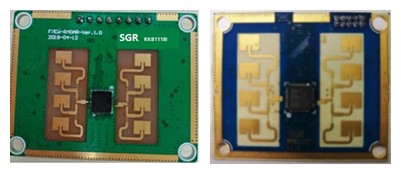
Three teams in this competition utilised Silicon杰’s millimetre-wave radar sensor modules, with two of them ultimately winning third prize. This clearly demonstrates the powerful capabilities of millimetre-wave radar in IoT and V2X applications, as well as its boundless market potential.
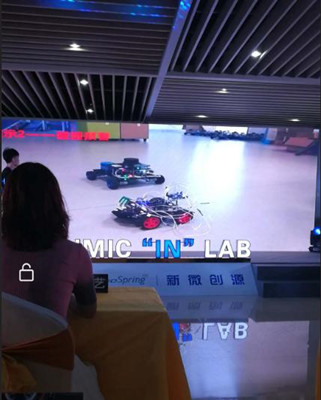
Competitors showcasing their entries (the front section of the small car in the image utilises a millimetre-wave radar module to detect obstacles ahead)
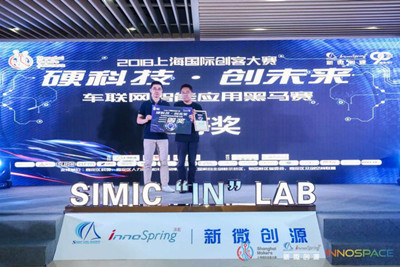
(A representative from Sijie presenting awards to the winners)
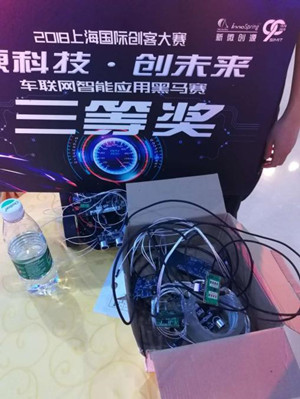
(Third-prize-winning entry, utilising a Sijie millimetre-wave radar module)